
History – Sir Thomas Dunk: Life and Legacy
Early Background
In the early 14th century Edward III invited clothiers from Ghent in Flanders to come to England and establish their trade here and teach others the weaving trade. John Kemp, a Flemish master clothier, was soon appointed by the King to oversee this process. In about 1338 he brought over another Flemish clothier, one Doncke, Duncke, Dunke, or Dunk to England and he settled a short distance east of Hawkhurst, in Hinksden. The Cloth Hall he built is now known as the ‘Paper Mill House’.
Between them, these two Flemish or Dutch weavers were the founders of the cloth industry of England, which itself was founded upon the wool trade. Led by the Dunks, the Weald of Kent became a particularly popular destination for further immigrant Flemish clothiers – wool was abundant and there was plenty of water and wood. The clay soil was also an advantage as the clay extracted was highly absorbent and was used to cleanse the finished cloth. In all, about seventy Flemish families settled in the Weald.
The Dunks later diversified into iron and there is evidence of early iron workings on the Tongswood estate, from at least the end of the 15th century. The early Dunks made a great deal of money. At some stage they built a house – the seat of Tongs – on the present site of Tongswood, which is recorded as the seat of the family when Simon Dunk died in 1512. Tongswood passed through several generations of the Dunk family to Simon Dunk, who died in 1617, and then to his heir, Thomas Dunk. It was later owned by Sir Thomas Dunk Kt. Over this period the estate grew to around 1200 acres.
Sir Thomas Dunk (1657-1718)
-
Who ruled England during his lifetime?Read more:
1653-1658 Oliver Cromwell, Lord Protector of the Commonwealth
1658-1659 Richard Cromwell
1660-1685 King Charles II
1685-1688 King James II
1689-1702 King William III and Queen Mary II
1702-1714 Queen Anne
1714-1727 King George I
-
What was happening in England at the time?Read more:
Most of the people in Britain still lived in the countryside. In the local law courts, punishments were harsh. If you were caught stealing sheep or poaching, the sentence could be hanging or transport to the colonies. Landowners began to create ‘enclosures’ by fencing off part of their own and common land. Often villagers were forced to work as labourers on very low wages, or they left the country to seek work in the growing towns. Poorer working women found themselves exploited for their labour.
The Agricultural Revolution brought huge changes in farming methods and machinery to feed a growing population, establishing practices such as enclosing fields with hedges, not letting the land lie fallow but plant in succession with diverse crops, and the invention of seed drill, reapers, threshers and other machinery.
The year 1665 marked the last occurrence in Britain of the Black Death, the bubonic plague that was transmitted by fleas carried by rats – victims developed large swellings and a raging fever and died within days.
1707 Union of England and Scotland
Steam engines were at the heart of the transition from creating goods by hand to using machines and the first was invented in 1698 by Thomas Savery to pump water out of Cornish tin mines. In 1713 Abraham Darby began using coke instead of charcoal to smelt iron. Ironmaking became one of Britain’s most important industries and iron was used to build the tools, bridges, machines and later railways of the Industrial Revolution.
People still believed in witchcraft – during the 17th century witch-hunting became a mania. In England over 200 women were hanged in just two years. Records show that the Bideford witch trial in 1682 resulted in the execution of the accused and in 1716 Mary Hicks was condemned and executed as a witch.
Sir Thomas Dunk is the most famous member of the Dunk family but relatively little is known about his life. Clearly born into riches, he achieved fame through his own merits. He served an apprenticeship in London as an ironmonger and was given the Freedom of the City to set up in business. As a Freeman of the City, he joined the Guild of Ironmongers who, along with the other City Guilds, had the power to elect the two Sheriffs of London. In 1709 Thomas was elected by his fellow liverymen as one of the two Sheriffs and on 18th January 1710 he was knighted by Queen Anne. For several years he also served as a Governor of St Thomas’s Hospital in London.
-
What were men of Sir Thomas Dunk’s social class wearing?Read more:
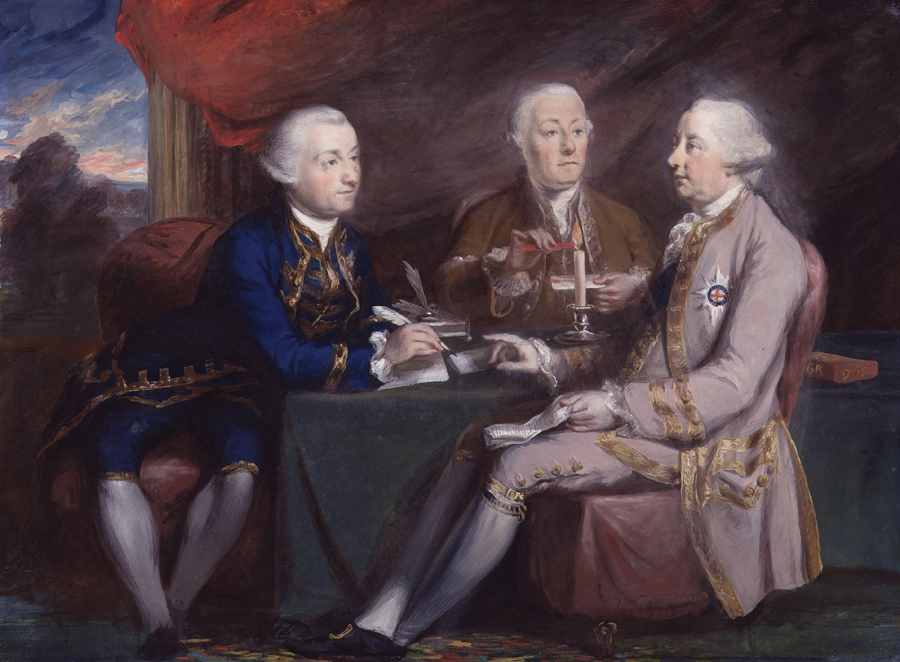
Lord Halifax and his secretaries, attributed to Daniel Gardner, after Hugh Douglas Hamilton, circa 1765-1767, NPG 3328, reproduced by kind permission of the National Portrait Gallery. Lord Halifax is on the right, with white wig and Garter ribbon and star, dictating to a secretary.
A typical outfit consisted of a full-skirted knee-length coat, knee breeches, a vest or long waistcoat, a linen shirt with decorative ruffle (jabot). Lower legs showed and were an important part of the silhouette. The whole ensemble was topped by a shoulder-length full-bottomed wig and a tricorne (three-cornered) hat.
Sir Thomas was married twice, but had no surviving legitimate children. His first marriage, on 10th December 1676 at All Hallows, London Wall, was to Mary Morris. She was buried as Mrs Mary Dunk on 10 March 1702 at St. Margaret’s, Westminster. Sadly all the children that she bore Sir Thomas died in their early years: Sara Dunke (baptised 26 September 1677, St Martins in the Fields, buried 26 June 1685, St Margaret’s, Westminster), Mary Dunke (baptised 23 October 1678, St Martins in the Fields, buried 5 May 1682, St Margaret’s, Westminster), Thomas Dunke (baptised 20 April 1682, St Margaret, Westminster, buried 2 June 1685, St Margaret, Westminster), Elizabeth Dunke (baptised 6 May 1686, St Margaret, Westminster, buried 3 July 1695, St. Margaret’s, Westminster), Ann Dunke (baptised 16 March 1688 and buried 22 March 1688, St Margaret, Westminster).
Sir Thomas married again, on 6th January 1704. This marriage, to Cornelia Palmer, took place in Temple Church, Fleet Street, London. Cornelia died in May 1717 and was buried in Chelsea, London.
-
What was happening in Hawkhurst at the time?Read more:
Hawkhurst village sign
Apart from iron making, wool working was the most important industry in Kent at this time. Sheep were raised on Romney Marsh and immigrants from Flanders taught the people of Kent the skills needed to turn wool into cloth – step by step. After being degreased with Fuller’s earth, the wool had to be carded to get rid of lumps and tangles. Then it was spun. Both these jobs were slow but could be done at home, usually by women. The wool was then woven – for example in a large hall in Cranbrook which had been built for this purpose. That was the beginning of the factory system which took over from the ‘putting out’ system where the wool was turned into cloth in homes. Wool was used almost exclusively for clothing until the arrival of cotton goods in the late 17th century. The Weald of Kent was one of the centres of England’s cloth producing industries.
Hawkhurst was one of the main operations centres for the notorious ‘Hawkhurst Gang’ of smugglers. The Gang dominated smuggling across the south-east in the 1730s and 1740s. When Highgate Hill was cut in 1763 smugglers’ underground passages were exposed to the ‘Royal Oak’, then a noted posting hostelry on the London-Rye highway.
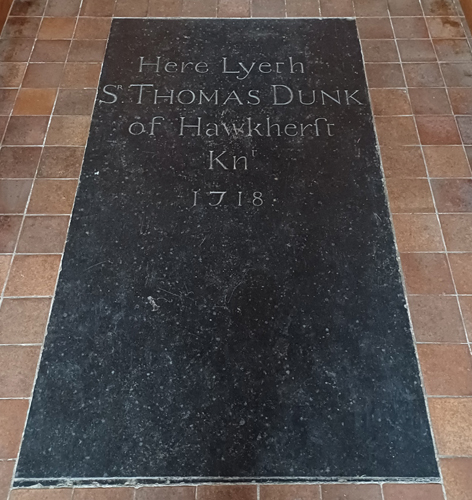
Sir Thomas died at Tongswood on 14 August 1718, and was buried on 17 August that year in St Laurence Church, where he used to worship. He requested that he be buried in the aisle just before his pew. You can still see his impressive memorial slab inside the church today. He left an extensive will, with many individual bequests.
-
The Dunk portraitsRead more:
Records show that at one time a pair of large portraits of Sir Thomas Dunk and of his wife were on display in the hall in Dunk’s almshouses in the centre of Hawkhurst. In 1927, Dunk’s trustees asked Hawkhurst Parish Council to hang the paintings in the Victoria Hall – then the village hall, now the Kino – so that members of the public could see them. It appears that the paintings were moved there in 1929.
They were in the Victoria Hall until about 1950 but seem to have been lost in the refurbishment that took place in the hall in 1951. In 1989, Miss Elizabeth Clarke, researching the records of Dunk’s Charity, found mention of the portraits and enquired as to their whereabouts. However, all efforts to locate the portraits since have been without success. As a consequence, Dunk’s Charity does not possess a picture of its benefactor, Sir Thomas Dunk.
Later History of Dunk’s Estate
Sir Thomas’s sole executor was William Richards who, by the terms of the will, eventually inherited the estate in 1733. He married Anne Davis, daughter of Sir John Davis. In due course their daughter, also called Anne, inherited Tongswood but to do so, Anne had to change her name to Dunk.
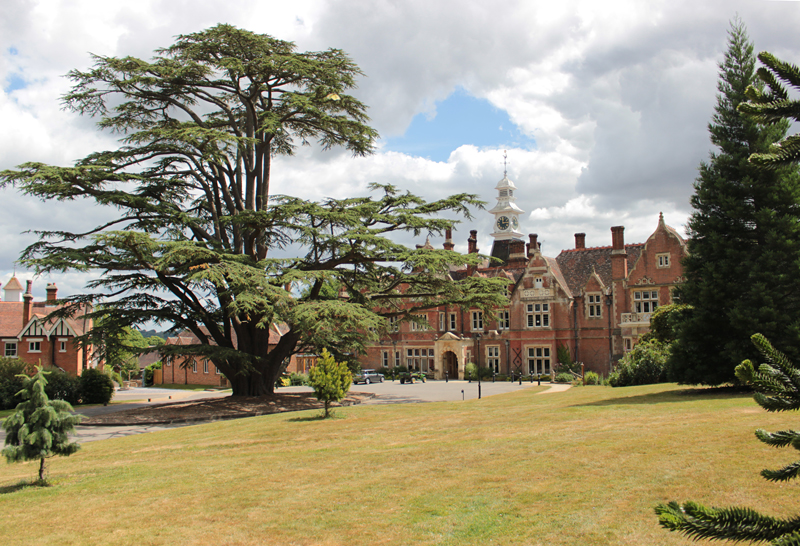
She married the Hon. George Montagu in 1741, who in turn added the name Dunk to his surname. Anne brought an enormous fortune (£110,000, worth over £17 million in today’s money) to her husband, but died prematurely in 1753 at the age of only 28.
George Montagu-Dunk was the son of the 1st Earl of Halifax and succeeded his father as 2nd Earl of Halifax in 1739. Between 1748-60 he was the President of the Board of Trade and was styled ‘The Father of the Colonies’. Halifax, the capital of Nova Scotia, founded in 1749, was named after him. In 1757 he joined the Cabinet, where he held several important positions. He died on 8th June 1771 and has a monument in Westminster Abbey.
Lord Halifax leased Tongswood to Jeremiah Curteis of Rye for one thousand years, for a yearly rent of six pence. Interestingly, Curteis happened to be one of the leaders of the infamous ‘Hawkhurst Gang’ of smugglers. In 1767, Curteis conveyed his interest to William Jenkins, who died in 1784. The estate was then sold to Mr David Langton and it then passed through the Wilson and Cole families. Today it is the site of Saint Ronan’s School.
The Bequest: Dunk’s Almshouses and School in Hawkhurst
In his will, Sir Thomas Dunk left the sum of £2,000 and land to build almshouses and a school for boys in Hawkhurst on the Rye Road and also made provisions to pay for the schoolmaster’s salary. £2,000 would have been a significant sum at the time. Sir Thomas stipulated that almshouses and school be built within five years of his death on 14th August 1718.
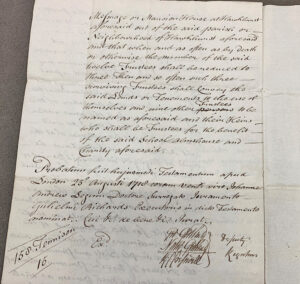
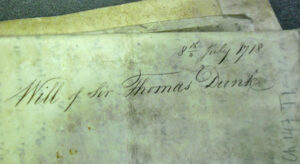
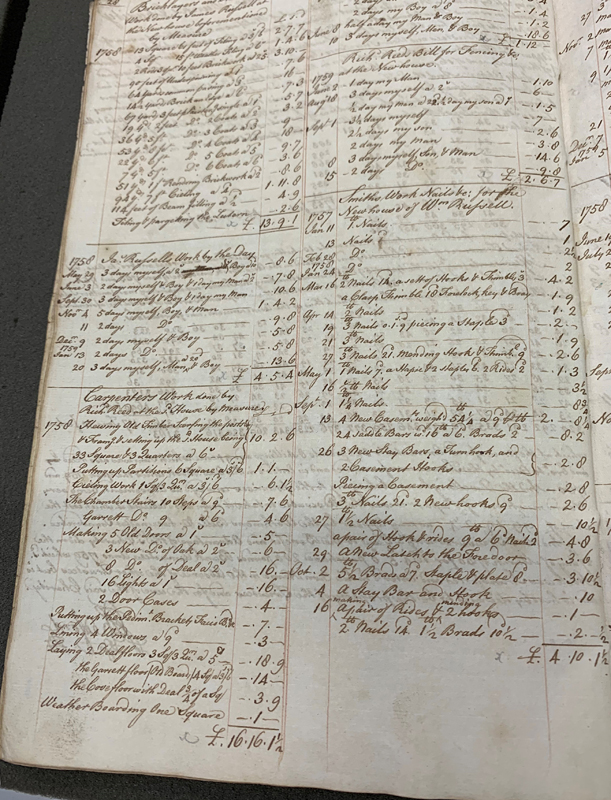
Sir Thomas’ executor William Richards gave a great deal of thought to how best to implement his benefector’s plans for almshouses and school, and in particular to how the annual sums that Sir Thomas had stipulated should go to each resident and the schoolmaster could be augmented. With this in mind Richards bought and upgraded Tilden Farm so that the rent paid by Tilden Farm’s tenants would be sufficient to endow Dunk’s Charity and help pay for repairs. The first tenant of Tilden was John Patrick who in 1727 became Treasurer of Dunk’s Charity.
Edward Hasted in his ‘History of Kent’ (Vol VII, pp 152-3) records:
“SIR THOMAS DUNK, by will in 1718, gave the sum of 2000l. to be laid out in building and endowing a free school and six alms-houses at Highgate, for six decayed housekeepers, three men and three women; the schoolmaster to receive 16l. and the alms-people 6l. each per annum. The school and alms-houses were accordingly erected and endowed, by William Richards, esq. his executor; (the surplus of these sums, after the compleating of the buildings, being laid out in the purchase of a farm, now let at 70l. per annum); who, to make the building and endowment more complete, added to the 2000l. about 600l. of his own money, and further by his will ordered, that a further sum, not exceeding 250l. should be laid out in the purchase of lands, the income of which should be employed to augment the salary and pensions payable to the master and alms-people. In pursuance of which bequest, George Dunk, earl of Halifax, who married Anne, only daughter and heir of William Richards, (as being the representative of the executor of Sir Thos. Dunk, as perpetual visitor) in 1753, in consideration of the said 250l. and 70l. raised from the sale of timber from Tilden, the estate settled before on this charity, conveyed to the trustees of it, and their successors for ever, being the minister of Hawkhurst, and ten others, a messuage and land lying near Fourtrows, in this parish and in Sandhurst, of the yearly rent of 17l by which means the salary of the scoolmaster was augmented to 20l. per annum, and the alms-people to that of 7l. per annum each.”
We have accounts of how the building of the almshouses progressed but it was not until 1723 that the first residents moved into the almshouses and the first 20 boys were admitted to the school. Interestingly, some of the first pupils’ surnames are still familiar in Hawkhurst today and it is noteworthy that the almshouses building itself has remained outwardly unaltered to the present day.
The School
The boys’ school room was situated in the central hall on the ground floor in the almshouses, under the clock. The first schoolmaster, appointed to start up the new school in September 1723, was one Joseph Whood. Sir Thomas’s will stipulated that the school was to be for 20 boys but when Mr Whood died on 22 August 1743 the register showed 35 boys in the school. The next schoolmaster was John Corker. 22 boys are listed in the 1745 register, in 1748 just 16 boys are listed, by 1751 numbers are back up to 27. Mr Corker’s length of service was notable: in July 1776 he was retired and given an almshouse. The third schoolmaster was Philip Wallis.
In 1894 a cloakroom for the pupils was erected at the front of the building – the Board of Education approved the building of this cloakroom on condition that the size of the windows was increased. (The cloakroom was demolished in 1970.)
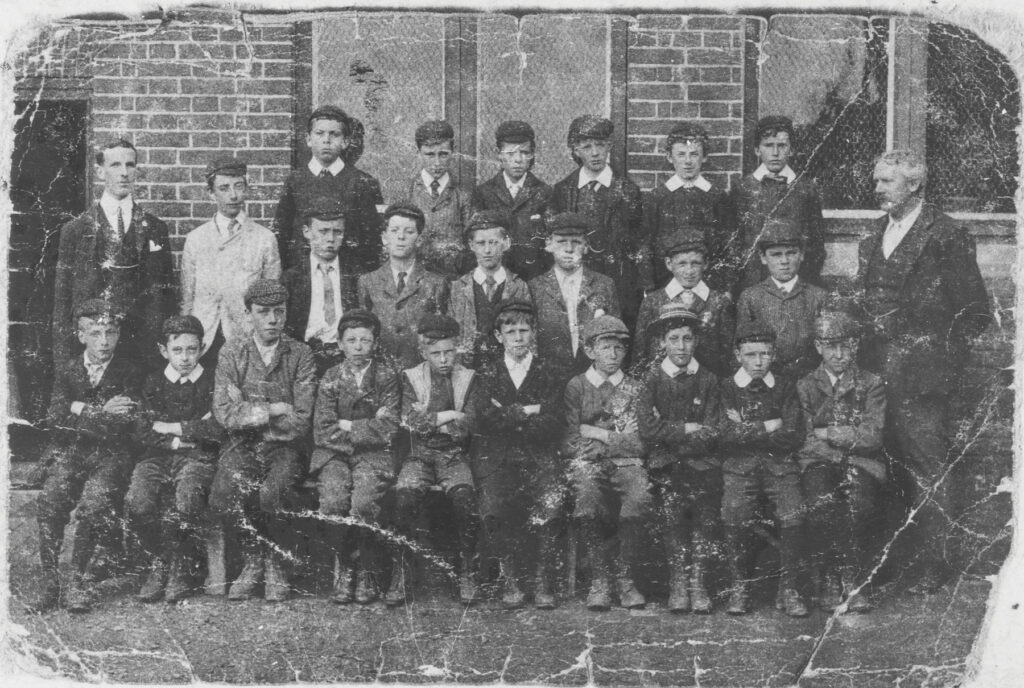
A C Moore was the last headmaster of Dunk’s school for boys before the school closed in 1923. The Rootes brothers William and Reginald as well as Lewis and Cyril Waghorn were among his pupils.
Continuing Dunk’s Educational Objective
When the school for boys closed in 1923 after 200 years, it continued as Dunk’s Educational Foundation, supporting young local people in their quest for continuing education with grants for various causes and projects.
DEF is a modern interpretation of how best to use the schoolroom which Sir Thomas provided for Hawkhurst boys – at present the former schoolroom is available for hire and proceeds from this go to the educational grants fund. Every year local families can apply for a grant if their children need financial assistance with education related projects and causes and so Sir Thomas Dunk’s legacy still flows back to benefit the young of Hawkhurst.
You can support the work of Dunk’s Educational Foundation by visiting Dunk’s GoFundMe page where you can make a donation, anonymously if preferred.
Clock and Clocktower
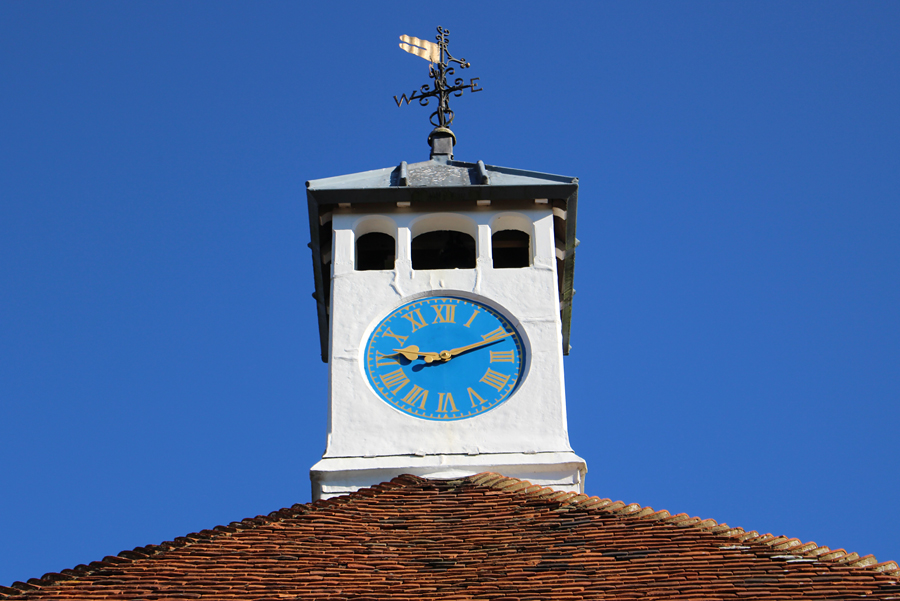
The clock sitting atop the middle section of the almshouses is a prominent feature of the almshouses’ design.
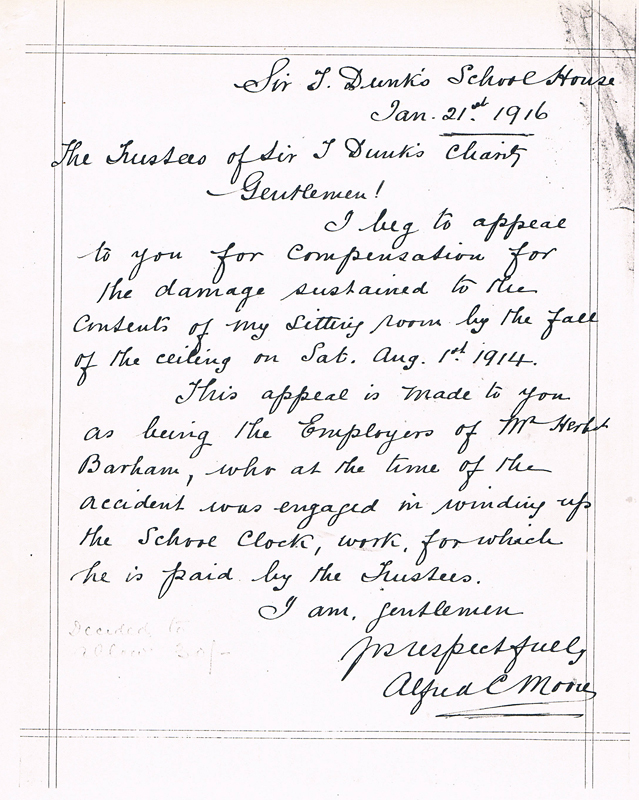
Sir T. Dunk’s School House
Jan. 21st 1916
The Trustees of Sir T Dunk’s Charity
Gentlemen!
I beg to appeal to you for compensation for the damage sustained to the contents of my sitting room by the fall of the ceiling on Sat. Aug. 1st 1914.
This appeal is made to you as being the Employers of Mr Herbert Barham, who at the time of the accident was engaged in winding up the school clock, work for which he is paid by the Trustees.
I am, gentlemen,
Yrs respectfully Alfred C Morris
In 2021 the clocktower in Dunk’s almshouses underwent a complete refurbishment carried out by Colin Faulkner, Dunk’s Buildings Trustee. The oak plinth holding up the weather vane, which we believe to be the building’s original dating from 1723, had worn away and was replaced with a solid piece of English oak. Whilst the wooden slats of the actual tower were found to be sound the struts holding them together were completely rotten and were replaced with fibreglass – much lighter than the original wood. The weather vane and clock face numbering were both repainted in 24 carat gold paint by Nick Faulkner.
Additional Accommodation
Towards the end of the 20th century four bungalows were built in the grounds behind Dunk’s almshouses – these bungalows offer accommodation suitable for couples. The imposing white building to the right of Dunk’s almshouses was the Westminster Bank building, part of which was used as the manager’s residence. When the entire property was taken for business, the manager’s redundant back garden was given to Dunk’s Almshouse Charity to build four additional dwellings. These were opened by Lord Mayhew in 1999.
Dunk’s in the 21st Century
Today, over 300 years after Sir Thomas Dunk’s death, his charities in Hawkhurst continue his legacy: Dunk’s Almshouse Charity provides affordable accommodation for local people who meet the charity’s criteria and Dunk’s Educational Foundation supports young people with a connection to Hawkhurst in their quest for continuing education.
Throughout the centuries up to the present time, Trustees have administered the day-to-day running of both Dunk’s charities. Only more recently has the position of a salaried Clerk to the Trustees been created to support the work that needs to be carried out. This includes maintenance of the listed building inside and out as well as looking after the social side of residents’ lives.
The almshouses provide independent living but a community atmosphere is important and welcome – so there are regular coffee mornings, outings to interesting places in the vicinity, Christmas gatherings for residents and Trustees, and more. The residents themselves choose to get involved in the communal life at Dunk’s as much or as little as they want to – for example help tend the beautiful gardens or assist with events at Dunk’s.
Today more than ever, Dunk’s plays a vital role in the life of the village – assisting, nurturing, constantly forging new connections in and around Hawkhurst to remain relevant. In June 2024, Dunk’s Charities involved the whole of Hawkhurst village – individuals, local organisations and businesses – in their 300 year anniversary celebrations, raising over £3,000 in the process for their educational grants fund. Sir Thomas would be justly proud of the good his legacy has done over centuries and is still doing today.
Dunk’s Almshouse Charity and Dunk’s Educational Foundation are part of the Almshouse Association.
-
About the Almshouse AssociationRead more:
There have been almshouses in the United Kingdom for more than 1000 years, with the oldest almshouse charity foundation still in existence being the Hospital of St Oswald in Worcester founded in 990. Many are old, others are modern and some are newly built.
In 1950 the National Association of Almshouses (The Almshouse Association) was established. Its objective is to assist charity trustees to manage their resources effectively, to support them in providing good quality housing for those in need, to promote the welfare and independence of residents and to preserve the historic tradition of almshouses for future generations.
Today, the Almshouse Association supports over 1600 member charities that provide homes for around 36,000 residents across the UK. It provides guidance manuals, policy documents and model templates, training seminars, and a platform to discuss best practices and share knowledge: www.almshouses.org.
Acknowledgements:
This historical account is indebted to research by
- Andrew Davis, former Dunk’s Clerk
- Ruth McChesney
- William Trelawny-Vernon, former St Ronan’s Headmaster
- Elizabeth Clarke
Photo credits:
- Dunk’s own
- Historic documents – source: Kent Archives, Maidstone
- Early 1900s photo of Dunk’s schoolboys – source: Historic Hawkhurst – People and Places, p.14 (2001 revised edition based on Lewis Waghorn’s ‘Hawkhurst – a Kentish Wealden Village’, published by Wealden Events Publications in association with John Dawes Publications, Hawkhurst)